
South Africa moves too much freight by road rather than rail. This is a financial burden for businesses with large volume haulage, such as timber.
With fuel-price volatility continuing, businesses are watching the country’s embattled rail system and asking when it will improve.
Progress has begun. Rail reform is a key element of the second phase of Operation Vulindlela (OV), a joint initiative of The Presidency and National Treasury working on structural reform – encompassing electricity, water, transport and digital communications, and revamping the visa regime – to support economic growth and job creation.
Freight logistics, including rail and ports, was one of five priority areas in OV Phase I (OVI) from 2020–2025. The phase concluded with 89% of its reform targets completed; the remainder is under way. As we noted in a story last year, Phase I’s reforms unlocked R500 billion in investment and helped boost business confidence.
In a historic move, agreements have been reached with 11 private train-operating companies.
Freight logistics remains a priority under Phase II, or OVII. In May 2026, 11 private train operating companies concluded rail-access agreements with the Transnet Rail Infrastructure Manager.
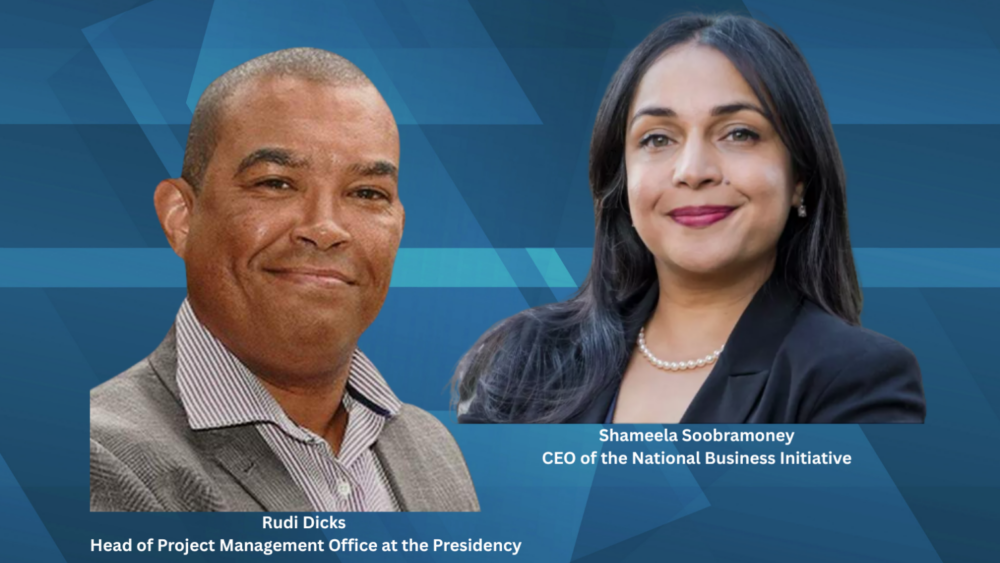
“For the first time, we’re opening up the rail network to private train operating companies,” said Rudi Dicks, head of the Project Management Office in the president’s private office, speaking at a recent NBI webinar that Dolphin Bay attended.
The agreements break the monopoly of the state-owned enterprise Transnet and are expected to add 24 million tonnes of freight capacity.
As is happening with electricity utility Eskom, “it’s about unbundling Transnet, separating operations and infrastructure, and ensuring we’re able to get private train operators into the system,” said Dicks.
Launched in 1995 by then-President Nelson Mandela, the NBI is an independent business movement of nearly 100 South African and multinational member companies committed to the vision of a thriving country and society. Dolphin Bay is a member of the NBI.
“Phenomenal” business support for the reforms
The organisation has been asked to provide technical support to OV by assessing the resources required, managing private-sector finances within the programme, and helping with reporting and contract management.
Business support for the reform agenda has been “phenomenal”, Dicks said, “and the NBI has been central.”
He described the decline in national rail volumes as “precipitous”. Volumes fell from 226.3 million tonnes in 2017/18 to 149.5 million tonnes in 2022/23, before partially recovering to a projected 168 million tonnes in 2025/26.
“That means that South Africa is moving less by rail today than it was doing a decade ago,” he said.
Government is aiming for a medium-term target of 250 million tonnes moved by rail, although “200 million tonnes is the key,” Dicks emphasised.
Much of OV does not require additional resources, but rather policy changes. For rail logistics, one of the most significant is the introduction of open access.
The additional capacity could lead to more competition, improved performance, and more operators introducing higher volumes.
The additional 24 million tonnes of capacity may be modest compared with the government’s medium-term target, but it is an important start. It could lead to more competition, improved performance, and more operators introducing higher volumes.
The logistics stream has also seen the publication of the National Rail Master Plan, which will guide the revitalisation, expansion and modernisation of South Africa’s rail system.
OVII launched in May 2025, making it just over one year into what is, in effect, a five-year plan. OV is structured as an ongoing reform programme rather than a fixed-term project, but Phase II’s goals are explicitly aimed at improving GDP growth by 2030.
Operation Vulindlela is as an ongoing reform programme rather than a fixed-term project.
Rail access is only one part of the reform programme. Other OVII measures concern ports, visas, electricity, telecommunications, infrastructure, and local government.
Another development is a technical assessment of a proposed independent National Ports Authority. This would separate the port infrastructure manager from terminal operators – a distinction intended to address Transnet’s historic conflict of interest as both infrastructure owner and terminal operator.
Dicks also pointed to South Africa’s Electronic Travel Authorisation system, which is intended to make short-stay tourism and business travel easier. Eligible travellers, from countries requiring visas, can apply online and generally receive an outcome within 24 hours. The system is being phased in and is currently available to eligible nationals of China, India, Indonesia, and Mexico travelling through designated international airports.
Lowering business costs, supporting job creation
Another achievement of OV is that the private sector has developed nearly 32GW of electricity-generation capacity – roughly double Eskom’s previous capacity.
The auction of the remaining 4G and 5G spectrum raised R14.2 billion for the fiscus. Dicks said data costs fell by 51% within a few months.
Together, all these reforms are intended to lower business costs, attract investment, and support job creation.
“The logistics, water, and electricity reforms continue,” Dicks said. If fully implemented – and OV is “ruthless about implementation” – the reforms could boost economic growth to 3.5% by 2029. He was referring to independent modelling by the Bureau for Economic Research.
“That’s when you see significantly net job growth; you see dynamic investment… That’s when things start sparkling,” he said.
Another measure is accelerating investment in public infrastructure. This will see R1.03 billion allocated mostly to roads, energy, and water and sanitation.
The reforms could boost economic growth to 3.5% by 2029. “That’s when you see significant net job growth… that’s when things start sparkling.”
Public-private partnerships are pivotal to achieving those infrastructure goals.
“Traditionally, we’d go to the market, get money, and then hand it over to state-owned enterprises to drive the investments,” said Dicks. “In this instance, we don’t have that fiscal space, so most of what we’re doing is through private-sector partnerships.”
For the timber industry, logistics is particularly important.
“As a timber-linked business, we will be watching this carefully,” said Bertus. “I’m sure many of Dolphin Bay’s clients would move their goods from road to rail where possible. Private-sector participation could be the deciding factor.”
As NBI host Ruth Troskie said at the end of the webinar: “For a very long time, this country wanted to have hope.
“We have hope now.”

- PRO-TREAT APP: “YOUR PLANT IN YOUR POCKET” - September 2, 2026
- DARGLE POLES JOINS THE QUALITY PLEDGE - September 2, 2026
- OPERATION VULINDLELA RAISES HOPE FOR RAIL REFORM - September 2, 2026


Comments are closed.