
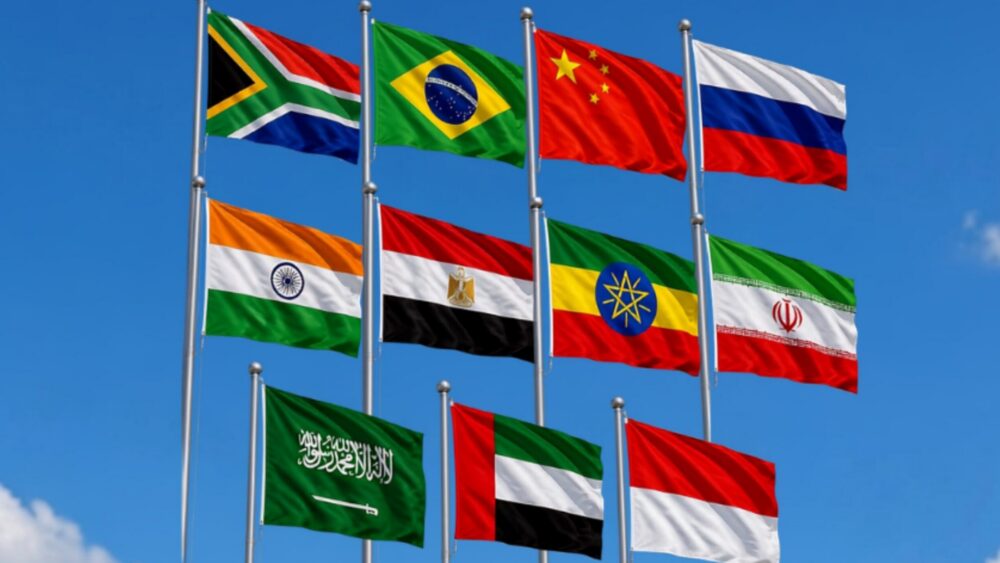
Ever since Brazil, Russia, India and China held the first BRIC summit in 2009, there have been whispers among economists that this emerging market bloc might form its own currency.
Those whispers amplified in 2011 when South Africa officially joined the group (making it BRICS), got louder in 2024 and 2025 when Egypt, Ethiopia, Iran, the UAE, Saudi Arabia and Indonesia were invited to an expanded BRICS+, and became louder still in recent months amid a volatile global economy.
It’s easy to see the appeal of a single currency. If you’re, say, a South African timber company wanting to buy a piece of equipment from a Chinese supplier, you’d have to convert your rands to a third-party currency (almost always the US Dollar), which would then be converted into your supplier’s Yuan.
It’s inefficient, but it’s how cross-border trade works, especially – and expensively – in Africa. As Absa’s Gerald Katsenga explained: “As a continent, we’re spending almost $5 billion a year by using third-party currencies as a common currency.”
So the thinking is simple: if the EU has a common currency in the Euro, couldn’t BRICS (or BRICS+) do the same thing?
“As a continent, we’re spending almost $5 billion a year by using third-party currencies as a common currency.”
The short answer is no. Or, at least, not without a significant overhaul of the participating countries’ financial systems.
South African Reserve Bank (SARB) Governor Lesetja Kganyago spelled these out in an interview with Metro FM in 2023: “If you want it, you’ll have to get a banking union; you’ll have to get a fiscal union; you’ve got to get macro-economic convergence. And importantly, you need a disciplining mechanism for countries that fall out of line with it. The euro project demonstrated just that.” (Both Bulgaria and Finland have been subject to disciplinary processes in recent months for running budget deficits in excess of the 3%-of-GDP threshold.)
A BRICS currency would also require the establishment of a BRICS Central Bank, which would take over the monetary policy functions currently performed by national central banks like SARB. (Kganyago would know that as well as anybody: he’d be out of a job.) Losing the independence of your central bank would mean losing your ability to set your own monetary policy and your own interest rates… and it would leave you at the mercy of other member states’ economic policies.
That’s a tough enough pill to swallow in the EU, where member states share borders. In BRICS+, Brazil and Russia, or South Africa and China, aren’t even in the same hemispheres.
An informal block, not a monetary union
What complicates this further is that BRICS+ is an informal bloc, not a formal political union like the EU, or a monetary union like the Eurozone.
Then there’s the question of trade imbalances. As Herbert Poenisch, a senior fellow at Zhejiang University, explained: “All BRICS member countries have China as their main trading partner and little trade with each other.” To remedy that, Poenisch argued that BRICS members would need far tighter exchange‑rate coordination (potentially pegged to China’s renminbi), and mechanisms to provide renminbi liquidity to deficit countries like South Africa.
And as Bertus has pointed out, a reserve currency would need to have sufficient hard currency reserves. Those are well established for the Dollar, but not so much for a BRICS currency. “It all turns around debt,” he said. “The question is whether a BRICS currency could finance the debt the dollar is currently financing. And the answer is no. At present, BRICS+ members do not collectively provide the scale of financial infrastructure that supports the US dollar’s role.”
“It all turns around debt. The question is whether a BRICS currency could finance the debt the dollar is currently financing.”
Bottom line? A BRICS+ currency wouldn’t work for the same practical reasons that Africa doesn’t have a unified continental currency. Under its Agenda 2063, the African Union sketched out plans for an “Afriq” or “Afro”, but those plans fall apart in the face of economic realities.
So, as Dr Kenneth Creamer of Wits University’s School of Economics and Finance told the Dolphin Bay Brief: “The possibility of a BRICS currency is still a long way off. Generally, companies involved in international trade in Africa and in other regions tend to prefer to use existing currencies. There have been some recent examples where BRICS+ countries, and other countries, have been promoting trade in their own currencies rather than using third-party currencies such as the US Dollar or Euro. Such instances are still quite isolated but may become a trend in future. Time will tell.”
That goes to the heart of the problem. Talk of a BRICS currency has been triggered, in large part, by the bloc’s move towards de-dollarisation… or away from the US dollar as the global reserve currency (a status it has held since 1944’s Bretton Woods Conference, which was held to design a stable post-WWII international economic and financial system).
Economist Jim O’Neill first coined the term BRIC in 2001. Like most economists (and like you, having read the preceding paragraphs), O’Neill has long dismissed the idea of a BRICS currency. But just recently, he’s started changing his mind.
“About 18 months ago, if you had quizzed me about all of this, I would have said it’s a fantasy, the idea that the BRICS countries can create some kind of alternative financial vehicle,” he told Reuters in a recent interview. “Who knows quite what the monetary system will be in the future?”
Instead of thinking big (as in, a BRICS+ currency modelled on the Euro), O’Neill suggests thinking smaller. The vast majority of global currency movements are linked to capital flows: trillions of dollars’ worth of stocks, bonds, derivatives, etc. But that’s not the question being asked by the South African timber company looking to buy machinery from China.
And in that sense, O’Neill suggests, it might be far easier to de-dollarise international trade in goods than to de-dollarise savings and investments.
“Common currency just for settling trade”
“Given the success of the Euro, perhaps it is feasible for BRICS+ members – especially the larger ones – to explore a common currency for use in settling trade among themselves, even if they resist liberalising their capital accounts,” he wrote in a recent blog. “The process would certainly be cumbersome at first, and it presumably would require a basket of participating countries’ currencies, weighted for their respective GDPs. But if this was part of a larger process to pursue freer and larger volumes of intra-BRICS+ trade, it could be worth the effort.”
Africa, under its African Continental Free Trade Area, has already created the Pan-African Payment and Settlement System (PAPSS), which enables real-time settlement for cross-border payments in distinct local currencies for 28 African countries. PAPSS bypasses the dollar and negates the need for a common African currency for cross-border imports and exports.
A similar system exists for BRICS, in the form of mBridge. Initiated by the Bank for International Settlements (BIS), it’s a multi‑central bank digital currency (CBDC) payment platform developed by China, Hong Kong, Thailand, the UAE and Saudi Arabia that enables real‑time cross‑border settlement without SWIFT… and completely bypasses the US dollar.
BRICS+ has since floated building its own version – a “BRICS Bridge” – based on similar technology. And while it would not be a BRICS+ currency in the sense of notes and coins’, it would be a significant step in that direction.

- PRO-TREAT APP: “YOUR PLANT IN YOUR POCKET” - September 2, 2026
- DARGLE POLES JOINS THE QUALITY PLEDGE - September 2, 2026
- OPERATION VULINDLELA RAISES HOPE FOR RAIL REFORM - September 2, 2026


Comments are closed.