
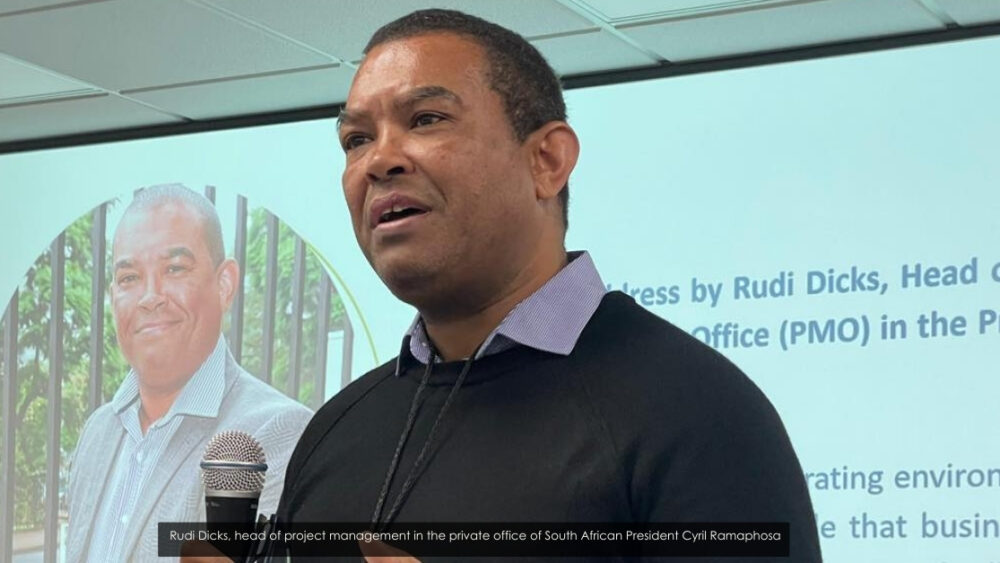
The head of project management in the private office of South African President Cyril Ramaphosa, Rudi Dicks, has praised the National Business Initiative (NBI) for its “pragmatism and lack of ideology” in helping to tackle South Africa’s greatest problems.
He was speaking at the latest NBI membership council meeting last month, which Dolphin Bay, a member of the NBI, attended.
Rudi said that “listening to business” had been a key aspect of Operational Vulindlela, the government plan to accelerate structural reforms to unlock economy growth and improve service delivery.
The NBI’s work has been fundamental in supporting government’s efforts, he said. “The NBI is not ideological… and provides pragmatic thought leadership.”
“We will continue to drive those reforms, no matter how difficult it is.”
About 75% of jobs in South Africa are created by the private sector. “We might think the state should create employment, but given the centrality of the private sector, we must improve confidence in private investment. We need a collaborative approach. In the last two years, we’ve seen that come to fruition in a more focused way.”
Unemployment cannot be solved by job creation alone; South Africa needs to support entrepreneurs. “How do we get young people to become entrepreneurs? It’s a mindset that’s about creating opportunities and also dealing with systemic issues.”
The NBI is playing a central role in addressing these issues, including through Operation Vulindlela.
Business helping to build better
At the 2018 Jobs Summit, government had discussed a “social compact” with business and labour. “The NBI, as an organisation providing strategic and thought leadership, was centrally involved.”
Many current initiatives had roots in this agreement, among them the Presidential Climate Commission, the Presidential Youth Employment Intervention, the Just Energy Transition, and ultimately, Operation Vulindlela.
Business had pointed out the systemic challenges hampering investment and thus job creation. “This included the forestry association saying you’ve got to sort our water licences out,” Rudi remembered.
Government addressed this issue, he said, which unlocked tens of billions of rands in private-sector investment. “It was our first success… There were fundamental issues from that Jobs Summit agreement that we’re now seeing the results of.”
Rudi also outlined the measures that led to the approaching end of loadshedding, in which business played a key part.
“We think we’re on the right path. And the reason we think that is that you, business, affirm it… We will continue to drive those reforms, no matter how difficult it is.”

- PRO-TREAT APP: “YOUR PLANT IN YOUR POCKET” - September 2, 2026
- DARGLE POLES JOINS THE QUALITY PLEDGE - September 2, 2026
- OPERATION VULINDLELA RAISES HOPE FOR RAIL REFORM - September 2, 2026





Comments are closed.