
Drive north from Johannesburg to Pretoria (Tshwane), weaving between the trucks and taxis as you pass that glittering monument to consumer culture that is the Mall of Africa, and you’ll find that you aren’t really driving from one city to another. Not anymore. Recent urban expansion has swallowed up Midrand, turning South Africa’s biggest city and its executive capital into one massive urban sprawl.
Johannesburg and Tshwane remain separate metropolitan municipalities, but their economies, transport networks, housing markets, and labour flows overlap seamlessly. Midrand lies at the centre of this transformation due to its position between the two cities and investment along the north–south transport corridor.
The entire region, while held together by transport, is governed in pieces. A worker may live in Midrand, work in Pretoria, and attend meetings in Johannesburg – but the municipalities responsible for transport, housing, water, and electricity function along differing lines.
With its population of twelve million, the Johannesburg-Pretoria axis has now passed the 10 million threshold to meet the UN’s definition of a megacity.
Five African cities are already megacities, in order of size: Kinshasa (the largest), Kano, Lagos, Johannesburg, and Cairo.
The number of megacities around the world quadrupled from 8 in 1975 to 33 in 2025. The United Nations expects that number to rise to 37 by 2050 – and that’s a conservative estimate.
According to World Population Review’s numbers, five African cities – Kinshasa (21.8 million), Kano (17.5 million), Lagos (14.8 million), Johannesburg (12 million), and Cairo (10.1 million) – are already megacities.
The need for mega-infrastructure
Africa’s rapid urbanisation is attributed to far better infrastructure and jobs in its cities than in rural areas, where economic opportunities remain limited and are tied to low-yielding agriculture.
Renowned South African futurist Bronwyn Williams agreed in a response to the Dolphin Bay Brief, pointing to “the pull of possibility” (the promise of economic opportunity) and “the push of poverty” as the rural poor move off their land and into formal or informal urban workforces.
“Africa’s future is urban,” the Institute for Security Studies proclaimed in 2016. In 2026, that future has arrived. But does Jo’burg (or any of its African peers) have the mega-infrastructure needed to support a megacity population, or at least the capacity to build it? Williams is sceptical.
“The infrastructure challenges are well documented and well founded,” she said. “The City of Johannesburg is, very literally, unable to keep the lights on and the water flowing for its existing residents. Infrastructure maintenance and preservation – let alone development for known expected population growth and demand – is nowhere near adequate.
“Infrastructure development becomes an albatross around any government’s neck.”
“Infrastructure development thus becomes an albatross around any government’s neck. The incumbent will be blamed for any prior administration’s failures, leading to all sorts of perverse incentives…. Which does not solve the problem.”
Johannesburg is not alone in this. As Williams noted, none of Africa’s megacities rank particularly highly on livability or quality of life. Joburg ranked 211th, on Numbeo’s latest list (mid-year, 2026), with Cairo (291st) and Lagos (stone last, at 305th) even lower down.
Gqeberha /Port Elizabeth (142nd), Windhoek (165th), Cape Town (166th), and Durban (179th) were Africa’s top four most livable cities. “But even then,” said Williams, “not all residents would agree.” Indeed, all four of those have elevated levels of inequality.
What a megacity SHOULD look like
“A model megacity should deliver a high quality of living – specifically safety, a reasonable cost of living (for all – not just rich foreigners), and good healthcare – in addition to access to infrastructure and natural endowments,” Williams said.
Good infrastructure, which enables the delivery of water, electricity, housing, healthcare, and even recreational facilities, lies at the heart of people’s quality of life. To build and maintain infrastructure, cities need finance and good governance.
Finance should not be a hurdle. The State of Africa’s Infrastructure Report 2025 by the Africa Finance Corporation found that Africa is not resource-scare: the continent already holds over $1.1 trillion in domestic capital, from pension and insurance funds to public development banks and sovereign wealth funds. The report found that unlocking these internal resources is not just possible but essential, and highlighted opportunities for boosting energy, transport and logistics, industry, and digital infrastructure.
In almost all global cities, except Tokyo and Seoul, the vast population comes with creakingly inadequate infrastructure.
This year’s State of Africa’s Infrastructure Report found that Africa’s vulnerability lies in the fragmentation and underdevelopment of the systems that could bring resilient growth from its abundance of resources.
It warned that infrastructure must be designed and built as a connected urban system that links energy, transport, and digital networks. However, external financing is retreating. Domestic capital must step up – underlining the importance of sustainable megacities that can support their own rapid growth.
For almost all global megacities (Tokyo and Seoul are the exceptions), the vast population still comes with creakingly inadequate infrastructure. That’s why UN-Habitat found that over 200 to 240 million people, representing half of Africa’s urban population, currently live in informal settlements.
Slum population to triple
The report predicted that Africa could see its slum population triple by 2050, driven by population growth and urbanisation without industrialisation.
“National and transcontinental infrastructure development is critical to African development,” said Williams. At the same time, developmental decay is obvious when economic growth and investment lag behind population growth.
“The reasons for underdevelopment are likewise known: weak governance, fragile institutions, low investor confidence, hostile global macroeconomic conditions, ruinous predatory national debts, etcetera… in addition to the perverse power incentives that prevent aligning political will with the will of the people.”
Several regions in Africa are building large new settlements or even cities.
Some regions of Africa, rather than improving infrastructure in existing cities, are trying a new strategy. They are building large new settlements or even cities to eventually replace the old, crumbling ones. The aim is to boost economies and create hubs that support regional trade corridors.
Nigeria’s Eko Atlantic City, located off the coast of Lagos, is one example. A $6 billion private-sector project being built on reclaimed land, it aims to create a financial and commercial hub that connects Nigeria to Atlantic trade.
Kenya’s Konza Techno City development is another. A $14.5 billion smart city near Nairobi, Africa’s “Silicon Savannah” is intended to become a regional tech and innovation hub, with funding sourced from a mix of national government allocations, Chinese concessional loans, South Korean development financing, and private-public partnerships. However, the project is delayed.
Bishoftu airport: a new megacity hub
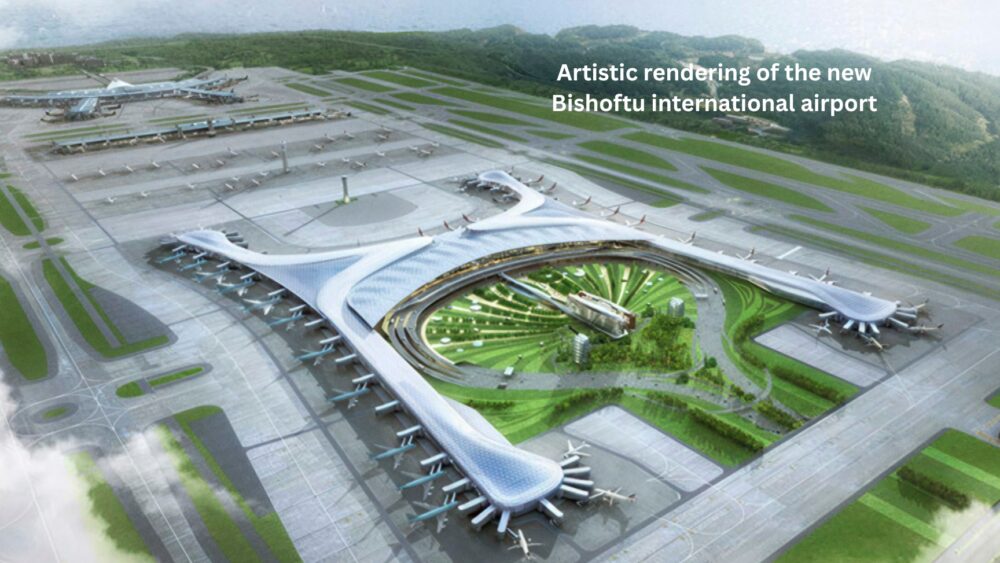
The most impressive example is Ethiopia’s $12.5 billion Bishoftu International Airport development. The mega-airport is being built for a capacity of 110 million passengers a year, making it a potential African megacity hub to rival any other around the world.
“Think Dubai… and then consider what it looked like 30 years ago,” said Bertus. “In 1992, Dubai’s population was just short of 700 000; today it’s more than 4.7 million – or as much as 6.4 million if you include commuters and visitors. That could be Bishoftu’s future.
“And Africa is the last remaining place where one can make significant infrastructure developments of this scale.”
Instead of under-resourced megacities, the continent could look forward to highly populated urban hubs supported by mega-infrastructure projects.
“Success breeds success, but you need pioneers to burn their fingers first,” Bertus concluded. “Right now, Africa is at the stage of paving the roads. Ethiopia’s landmark airport is a very modern, state-of-the-art development – enormously scaled, as they want to make a city of it. The hope is that this will be a nucleus, spreading out over the long term into East Africa’s other growing urban hubs.
“That’s a far more optimistic vision for the future of Africa’s megacities – and it remains entirely achievable, should governments carry the interests of their people at heart.”

- PRO-TREAT APP: “YOUR PLANT IN YOUR POCKET” - September 2, 2026
- DARGLE POLES JOINS THE QUALITY PLEDGE - September 2, 2026
- OPERATION VULINDLELA RAISES HOPE FOR RAIL REFORM - September 2, 2026


Comments are closed.