
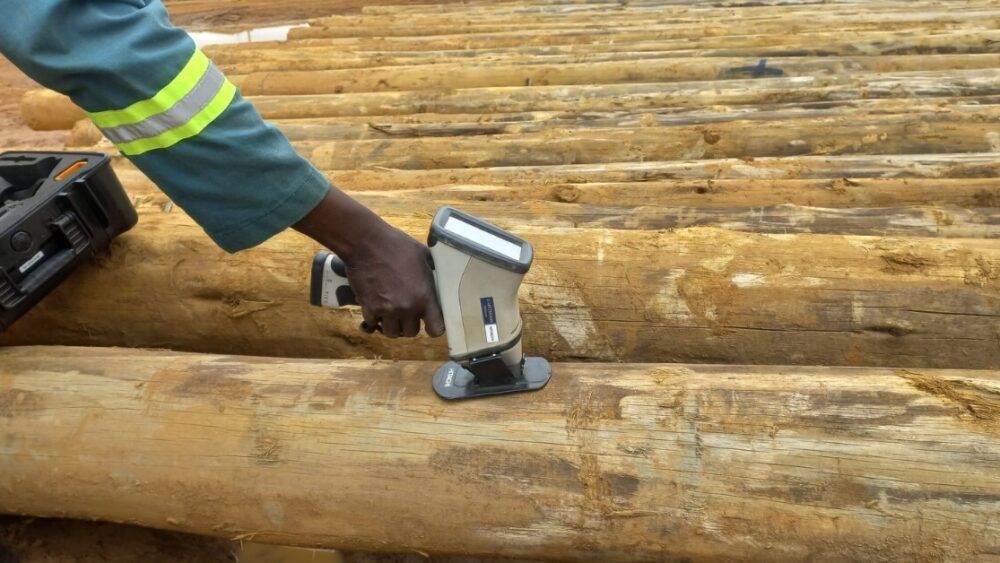
What’s the best way to verify the quality of CCA-treated timber? It’s a question asked in many markets, especially in Africa, where many countries lack a formal certification body.
In one market, a local utility company has acquired X-ray fluorescence (XRF) machines, which they are now using to conduct factory acceptance tests on treated poles.
The problem is that XRF machines were never intended for this purpose – and, by the manufacturers’ own admission, results can vary by up to 20%. That’s a significant margin of error and is why many timber treatment businesses are being left with a false impression of the quality of the products they’re producing.
“You get two kinds of XRF machine,” explained Dolphin Bay’s Darren Marillier. “There’s a desktop version, which is a lot more reliable; and a handheld machine, which is commonly used in mines for quick tests that give indicative results.
“Inconsistent, unreliable, inaccurate … These are not words one would want to associate with any measurement tool, let alone one that is being used to gauge the quality of products across an entire industry.”
“The machines are designed not as precision instruments, but for indicating the presence of metal components in ore. In the mining industry, samples would then be taken back to a laboratory for accurate analysis.”
XRF machines are not used in the South African timber industry. “Manufacturers here need to prove the quality of their products themselves, backed by accurate record-keeping,” Darren explained. “The verification is done by a certification body and regular site visits by inspectors. The industry in East Africa has no certification system and no on-site inspectors, so they’re using the XRF machine to fill the gap.”
It’s easy to see the attraction of handheld XRF machines: they are portable and convenient, and they provide instant readings. However, they should be used with care and discretion.
For example, if you were to simply paint CCA onto a pole without vacuum treating it, the XRF machine could give you a very positive reading.
“We’ve seen that happen,” said Darren. “The reliability just isn’t there. Neither is the consistency. We’ve had cases where Dolphin Bay clients have undergone inspections with the hand-held XRF device in the morning when it’s not as hot and there’s relatively little sunshine; then the same poles were inspected later that same day, under different environmental conditions, and the readings were totally different.”
Inconsistent, unreliable, inaccurate … Those are not words one would want to associate with any measurement tool, let alone one that is being used to gauge the quality of products across an entire industry.
We have also found that the calibration of the machine is critical to its operation. One of the settings is for timber density, which must be determined accurately before the XRF machine is used; yet there is a huge variation in the density of the eucalyptus used in different timber treatment operations.
“A wide range of analytical tools are available, and in our opinion, the industry should not rely on any one method,” said Bertus. “You need to use several tools, starting with a proper record-keeping system at your plant and a charge sheet that’s generated per treatment.
“That charge sheet will indicate that the timber has been properly treated. You can then do a desktop XRF analysis afterwards.”
Some customers, including utility companies, blame CCA when they find that poles perform poorly; meanwhile, it is the method of analysis that is at fault.
Bertus added that excellent record-keeping processes are available, and should be investigated by markets that rely solely on XRF machines.

- PRO-TREAT APP: “YOUR PLANT IN YOUR POCKET” - September 2, 2026
- DARGLE POLES JOINS THE QUALITY PLEDGE - September 2, 2026
- OPERATION VULINDLELA RAISES HOPE FOR RAIL REFORM - September 2, 2026





Comments are closed.