
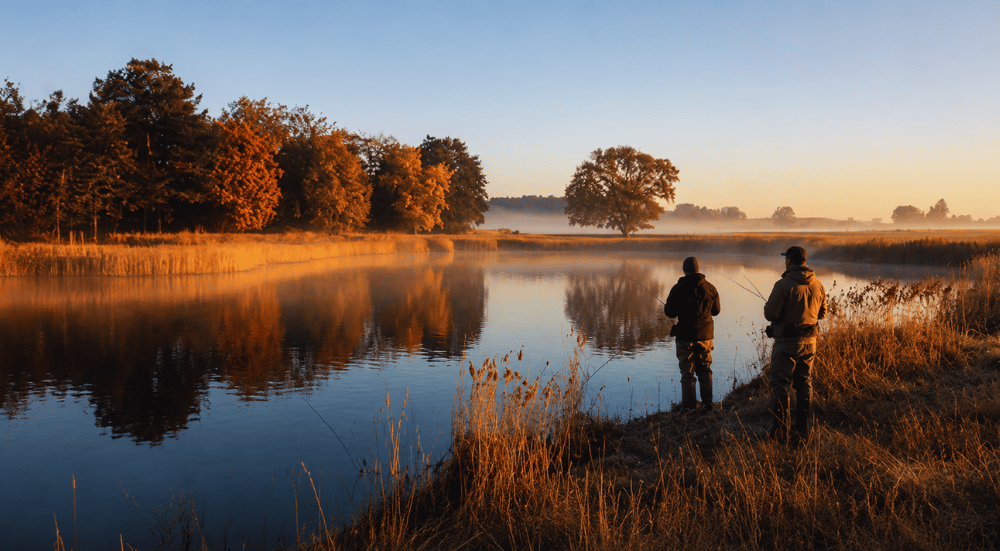
Life, business, politics… It all comes down to human relationships. And even the most difficult of deals can be settled through finding common ground. In one telling of the story, South Africa’s transition to democracy was navigated by enemies who became friends on a fishing trip.
It all started in August 1991. The National Party government and the recently unbanned African National Congress were tentatively feeling each other out in the “talks about talks” that would dismantle the Apartheid state.
As faith in the negotiations faltered, billionaire stockbroker Sidney Frankel tried a backdoor approach. Acting as a mediator, he invited his mutual business associates – young NP politician Roelf Meyer and ANC counterpart Cyril Ramaphosa, with their families – to his cottage near Dullstroom.
Tensions were high, and Meyer and Ramaphosa were certainly not friendly. “He was very much my enemy at that stage,” Meyer recalled in the History Channel documentary Miracle Rising. Ramaphosa, meanwhile, recalls not being told that Meyer had been invited.
Just before Meyer and his family arrived by helicopter, though, Frankel’s daughter fell and broke her arm – and so, the story goes, the Frankels hopped onto the helicopter and flew off to the hospital, leaving the Meyers and Ramaphosas alone to figure things out.
Meyer, a complete novice, went on the fishing trip… and almost immediately, disaster struck.
Meyer’s sons broke the awkward silence by insisting on going fishing – these being the trout-rich waters of Dullstroom, after all. Ramaphosa, a keen fisherman, offered to take them. Meyer, a complete novice, went along… and almost immediately, disaster struck.
As Ramaphosa later recounted: “He was so clumsy with a fishing line and a hook, it got embedded in his finger!”
After a long battle with the hook, Ramaphosa eventually removed it with a pair of pliers. With that twist of a fishhook, a mutual trust developed.
“I had the feeling I would like to know this man better,” Meyer recalled. “We came to understand each other, and we became friends.”
That friendship developed, not over braais and weekends away, but in backrooms and private meetings. The two men took the strategic decision not to appear too close in public; but when the official negotiations broke down, they would quietly slip away and return with a compromise.
Over time, Meyer and Ramaphosa emerged as leading figures in the backroom bargaining that led to democracy. Journalists called it “The Roelf and Cyril Show”. The two men remained – as Archbishop Desmond Tutu later remarked in the Truth and Reconciliation Commission hearings – “inseparable”.
“We want to welcome Mr Roelf Meyer. I thought that he had Cyril Ramaphosa in his pocket, because we did not see him for a very long time,” the Archbishop once joked.
Journalists called negotiations “The Roelf and Cyril Show”.
Reflecting on their relationship during that fragile period in South Africa’s history, Ramaphosa said: “We knew that as we dealt with each other, we would tell each other the truth as it stood. And if we made a deal, we would want to stick by that deal.”
In early 2026, amid strained diplomatic relations between South Africa and the United States, Ramaphosa – now President of South Africa – chose Meyer as the country’s US ambassador. There were, naturally, grumbles from the extreme wings of the political spectrum. But men like Meyer and Ramaphosa don’t operate in extremes. Their relationship was built on meeting in the middle.
Theirs is just one story of an unlikely friendship that shaped the course of history. Another began on a bus ride.
The 1971 World Table Tennis Championships were held in Japan during the height of the Cold War. After practice, American player Glenn Cowan accidentally got into the Chinese team bus – an extraordinary incident, given that the United States and China had had no diplomatic relations since 1949, and players from the two teams had very deliberately been kept apart.
No matter. Chinese player Zhuang Zedong welcomed Cowan aboard and struck up a conversation through an interpreter. Zhuang offered Cowan a gift: a silk-screen picture of China’s Huangshan mountains. Cowan returned the gesture the following day by giving Zhuang a T-shirt emblazoned with a peace symbol and the Beatles’ lyric “Let It Be.”
“I was as surprised as I was pleased,” US President Richard Nixon later wrote. “I had never expected that the China initiative would come to fruition in the form of a ping-pong team.”
Journalists captured photographs of Cowan and Zhuang together, and the unlikely couple became the talk of the tournament. Two days later, the US team received an official invitation to travel to China and play exhibition matches. The US accepted, laying the grounds for “Ping-Pong Diplomacy.”
“I was as surprised as I was pleased,” US President Richard Nixon would later write in his memoirs. “I had never expected that the China initiative would come to fruition in the form of a ping-pong team.”
That “China initiative” culminated in Nixon’s groundbreaking 1972 visit to China, the reopening of diplomatic ties between the rival superpowers, and the de-escalation of Cold War tensions.
Like Meyer and Ramaphosa, Cowan and Zhuang’s relationship created a space where personal trust could flourish even as institutions failed.
Psychologists call it the “contact hypothesis.” In his seminal 1954 book The Nature of Prejudice, social psychologist Gordon Allport noted: “Contacts that bring knowledge and acquaintance are likely to engender sounder beliefs concerning minority groups, and for this reason contribute to the reduction of prejudice.”
In other words: if you meet and get to know your opponent, he may well become your friend.
If you meet and get to know your opponent, he may well become your friend.
Between the time of “Ping-Pong Diplomacy” and the “Roelf and Cyril Show,” US President Ronald Reagan and Soviet leader Mikhail Gorbachev struck up a relationship based on those same grounds of mutual respect and shared purpose. Their first one-on-one meeting in neutral Geneva was scheduled to last just 20 minutes. It ran for an hour and a half.
One observer remembered Reagan’s words after that first encounter: “There’s a chemistry between the two of us,” Reagan said. “We listen to one another. We don’t agree, but maybe there’s a way to continue. We’ve got a long way to go here and hopefully we can find some kind of common ground.”
Reagan and Gorbachev’s repeated high-profile summits contributed to landmark arms-control agreements and, ultimately, the peaceful thawing of the Cold War.
The end of Apartheid, like the end of the Cold War, was a landmark moment in late-20th century history. In both cases, the solution to the problem lay in finding a shared space, and a shared humanity.
“This is very inspiring,” said Bertus.

- PRO-TREAT APP: “YOUR PLANT IN YOUR POCKET” - September 2, 2026
- DARGLE POLES JOINS THE QUALITY PLEDGE - September 2, 2026
- OPERATION VULINDLELA RAISES HOPE FOR RAIL REFORM - September 2, 2026


Comments are closed.